We promised to share some of our favorite examples of metal construction in Denver as we get closer to the AIA National Convention from June 20-22 at the Colorado Convention Center. Here’s our first:
Best known as the home of the NFL’s Denver Broncos, Mile High Stadium has been home to the likes of Peyton Manning and Tim Tebow. The metal stadium also was the venue for the 2008 Democratic National Convention, as well as concerts from bands including U2 and the Eagles.
Formerly known as Invesco Field at Mile High Stadium, Sports Authority signed a 25-year agreement for the naming rights in 2011. That should be a safe investment because the metal wall panels on that stadium will be looking great and performing well for many years to come.
The AIA National Convention is right around the corner, and the Metal Construction Association (MCA) is excited to expand its presence at the show this year. We’re not just planning to take up more floor space this year (though we will be bringing a shiny new display), we’re also excited to offer a new showfloor educational program for AIA CE credits.
So stop by booth 1303 within the Metal Pavillion between June 20-22, 2013 at the Colorado Convention Center in Denver to say hello, and see some of the exciting things MCA has to offer.
In the booth you’ll be able to see a mock roof and attic assembly that will demonstrate the energy efficiency of metal roofs compared to a conventional asphalt shingle roof. We’re also bringing along some of our favorite case studies and technical articles, and, of course, we’ll be there to answer questions.
We hope you’ve signed up for Scott Kriner’s seminar: “Metal Roofing: The Perfect Platform for Solar Technologies,” in which you will learn about metal roofing and photovoltaic systems, and why the two are an ideal pairing in new and retrofit applications. Scott, MCA’s technical director, will conduct the session on the convention showfloor in CE Theatre B (booth 4156) on Thursday, June 20, from 12:30 – 1:30 pm. We’ve heard that it’s sold out, but you may want to double check with AIA on-site, or feel free to stop by the booth to speak with Scott and find out when the course will be offered via free webinar.
We’re looking forward to being in Denver next week, and hope you’ll stop by to see us at booth 1303.
And be sure to check back here over the next couple of weeks–we’ll try to post some fun examples of of our favorite metal construction projects in Denver.
When it comes to new commercial construction, it’s helpful for architects and engineers to have reliable resources at their disposal for questions related to planning, designing, and building. The Metal Construction Association’s Ask The Experts is an online discussion forum for exchanging technical information concerning the use of metal in commercial construction, including general material and metal installation questions.
This spring has been a big season for new commercial construction projects and MCA has seen some trends with forum questions and discussions related to the following topics:
• Choosing Metal for Commercial Construction: New commercial construction can take a lot of building research between owners, architects, and engineers. For questions related to ‘choosing metal’, this topic is great for viewing previous discussions on metal being the best solution for commercial construction, types of metal, and more.
• Metal Installation: Installing metal for commercial construction can be a complex task for all engineers and contractors involved. For questions related to ‘metal structure installation’, this topic is great for viewing previous discussions on metal wall and roof installation.
• Metal Construction Engineering: Commercial engineering is a major part of the construction process with technical and strategic planning. For questions related to ‘metal construction engineering’, this topic is great for viewing previous discussions on testing, metal application, and diaphragms.
• Metal Maintenance: Building commercial structures with any material leads building owners to speculate on life expectancy, maintenance, and upkeep. For questions related to ‘metal building maintenance’, this topic is great for viewing previous discussions on common maintenance issues and weather myths.
• Metal Wall Panels: A popular commercial construction addition is metal wall panels. For questions related to ‘metal wall panels’, this topic is great for viewing previous discussions on Insulated Metal Panels (IMPs), manufacturers, and alternative wall solutions.
Find helpful metal construction discussions and create new topics for our expert panel. For more information related to these popular topics this season, please visit the Ask The Experts forum today.
Timex states “Takes a licking and keeps on ticking.”
DeBeers claims “A diamond is forever.”
These are some of the most recognizable taglines, and they all have a few things in common. Each supports the essence of its’ respective brand. Each appeals to the emotions of its audience. And each differentiates its brand from its competitors.
Earlier this year, the Metal Construction Association underwent an exercise to develop its own tagline. In addition to considering the qualities listed above, we considered a few additional key criteria: the tagline had to be short, memorable, and actionable.
After a rigorous brainstorming exercise in which member volunteers and staff reflected on the core values of the association and its members, MCA is pleased with where we landed.
MCA member companies make a host of amazing metal products that are used on many beautiful, high-performing buildings. These products are some the best performing, most technically superior, and most aesthetically pleasing metal buildings available.
Most of all, however, MCA recognizes that what we do is about more than just the metal construction and outcomes that our member companies make and the services they provide. These metal buildings become part of our culture and landscape. Because of the many performance and aesthetic characteristics inherent in metal roofs and preformed walls, they create a legacy that can last for generations.
And MCA, as a trade association, has been working for the past 30 years with its member companies to build a legacy of excellence, collaboration and innovation.
Stay tuned for more news about the evolution of the MCA brand over the coming months.
The list of design accolades for the Redding School of the Arts in Redding, CA, is impressive. It is the first new school campus in the world to receive Platinum certification under the LEED for Schools 2009 standards, and it also is expected to achieve Net-Zero. The school is designed to achieve the Collaborative for High Performance Schools (CHPS) certification, a national movement to improve student performance and enhance the education experience by building the best possible schools.
Photo Courtesy of Steve Whittaker
The design for the school was based on two essential ideas: First, the learning environment should create opportunities to show students, teachers and parents the importance of metal sustainability. Second, students should be inspired to learn in creative, colorful and fun surroundings. To help achieve these two ambitious functional and aesthetic goals, the design team turned to Metal Sales Manufacturing Corporation.
“We were looking for metal panels with recycled content, durability and an energy-friendly SRI (Solar Reflective Index) value,” says James Theimer, Principle of Trilogy Architecture who served as architect for the project. “Redding School of the Arts has been designed to last for 100 years. With the metal wall and roof panels, I think we found a product that would live up to that challenge.”
Photo Courtesy of Steve Whittaker
All of the metal panel colors used on the school are listed with ENERGY STAR®, improving energy-efficiency and reducing the amount of energy needed for cooling. The panels also have a long life cycle that will endure the wide temperature variations of the Sacramento Valley, are 100% recyclable, and contain a high percentage of recycled material – contributing to LEED points.
The use of metal wall and roof panels helps give the facility a smart and modern look worthy of its high-profile, high performance mission.
How do you design a Chicago cultural destination that will carry out the mission of the building owner, the Poetry Foundation, to celebrate the best poetry and put it before the largest possible audience?
Certainly, it’s no easy task. But renowned architect John Ronan of John Ronan Architects, Chicago, chose to wrap much of the new Poetry Foundation Building in a black zinc perforated screenwall, fabricated by VMZinc and installed by Tuschall Engineering Co., Inc., so that, when viewed from the front, the metal building becomes transparent and invites those on the street into an open-air garden to hear poetry and enjoy a place of quiet contemplation.
The garden is an urban sanctuary of sorts—a space that, according to Ronan, “mediates between the street and the building, blurring the hard distinctions between public and private.”
Ronan said the design of the building and the use of materials, such as perforated zinc wall panels, are intended to mirror the way in which people read poetry. “Just as good poetry doesn’t always divulge all of its meanings on the first reading, the new building will engage the public’s curiosity and unfold in states,” said Ronan.
Opened in June 2011, the Poetry Foundation’s new 22,000-sq.-ft., LEED-Silver home is one of only a few public spaces in the country built exclusively for the advancement of poetry.
With the help of zinc wall panels, you’d never guess that this retail building, located in Hyde Park on the south side of Chicago, was formerly a Borders bookstore. The black and patina-blue VMZinc flat lock panels are not only versatile and extremely durable, but they add visual interest, even an edginess, to the building design, say Jim Tuschall of Tuschall Engineering Company Inc., Burr Ridge, IL, and architect Wil Bruchmann of Antunovich Associates, Chicago.
The project serves as an anchor to a revitalized retail street corridor near the University of Chicago campus. Slated to open in June, the building houses a women’s clothing store and yoga studio in the front portion colored blue, and a high-end restaurant and music venue in the black- colored back.
“I was drawn to the patinaed zinc because its color changes slightly with the time of day, weather, and seasons. Every time you look at the building, it has a whole different color that can range from gray to aqua blue to anywhere in between,” says Bruchmann. “The panels are uniform height but random lengths. Adding detail to the wall also created a dynamic transition between the two colors, which mimic the differing uses within the building.”
Bruchmann also notes the long life of zinc. “It ages well over time and is very resilient,” he says. “There’s no question in mind that this was the best product for this particular project. There’s no other material out there that could create this sort of look and feel.”
In honor of St. Patrick’s Day, the Metal Construction Association (MCA) has decided to celebrate our favorite metal green buildings; figuratively and literally. MCA—and its members—embrace the green construction movement, and support sustainable and energy-efficient products. Here is a list of some green projects we hope you will find interesting and inspiring.
Coined “the office of the future”, the Pixel Building is the first carbon neutral office building in Australia, and has received the highest Green Star rating ever awarded by the Green Building Council of Australia. With striking, multi-colored metal MCM panels from Alpolic on the exterior, the building is sure to grab the attention of passersby.
GoodFellow Air Force Base, Texas
Goodfellow Air Force Base, San Angelo, TX
No, this Department of Defense facility is not olive drab, but the project earned a place on this list because its recent metal-roof retrofit includes integrated renewable energy technologies that will maximize electricity generation. The roof also has a rainwater capture system that will be used for irrigation purposes on the base.
A true American icon, the Empire State Building is bathed in green lights for St. Patrick’s Day. In 2012 the building was outfitted with a new, energy-efficient LED lighting system that will make this year’s St. Patrick’s celebration even more green. Find out when you can view tower’s lights with their schedule.
More often than not, architects and designers choose Insulated Metal Panels (IMPs) for a combination of reasons, not the least of which is aesthetics given that they come in a variety of styles, sizes, colors, finishes, and textures and can be installed both horizontally and vertically. Metl-Span’s Tuff Wall® IMPs, for example, provide a stucco-like appearance to the new corporate-headquarter addition to the Hitchiner Manufacturing facility, Milford, NH, a casting supplier to manufacturers in the aerospace gas turbine engine industry. But according to Dennis Mires, PA, of The Architects in Manchester, NH, IMPs also met insurance requirements, stayed within the owner’s budget, and provided a high-tech look for the company.
With that in mind, what are top reasons for choosing IMPs? Industry experts say that the metal panels:
are energy-efficient. IMPs have two metal skins, an interior and an exterior, which are bonded to a foam polyisocyanurate insulation core, making them highly energy efficient, said Brian Jaks of Green Span Profiles, Waller, TX, a manufacturer of IMPs. Initially used on cold-storage facilities, the panels have R values as high as 8 per inch, compared to 3.7–4.3 per inch for batt insulation, and range in thickness from 2–6 inches.
have thermal performance. According to Ken Buchinger of Metal Building Components, Inc., who recently spoke at METALCON, IMPs provide continuous insulation and consistent R values across walls, and have concealed fastener systems that prevent thermal bridging between the exterior and interior skins. He further noted that IMPs tend to hold their R value over time and do not have significant thermal drift.
allow for fast installation. IMPs’ one-piece construction makes for faster installation, Buchinger said. Faster installation helps lower construction costs and interim financing costs. Moreover, he said, the steel skins are resistant to abuse and, compared to conventional building envelope materials, are not as affected by adverse weather conditions such as high winds.
are suitable for green building. IMPs were used on the new LEED-gold-certified “Bartholomew Building” addition to William Allen High School in Allentown, PA, for their simplicity of design. “The [system] just goes together,” said Mitch Miller, associate and director of specifications of USA Architects, Easton, PA. “You’re installing the insulation and the finished panel at the same time.” Furthermore, the metal in a panel’s skin often has a high content of recycled steel or aluminum, and, when IMPs are removed from a wall, they can be recycled or re-used on another project, saving them from the landfill.
offer unsurpassed design flexibility. “People like the panel because it has a flat appearance,” Jaks said. “It doesn’t necessarily have corrugation and architects like that.” He added that IMPs are available in a variety of textures, including smooth, embossed, and heavy embossed. They also come in wide range of colors, and can be customized to match any color palette. IMPs’ design flexibility allows the ability to achieve almost any look and increase curb appeal.
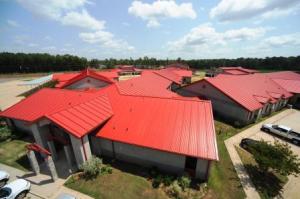
Haughton Middle School
are well suited for roof applications. More than 130,000 sq. ft. of IMPs was used to reroof the eight-building Haughton Middle School complex in Haughton, LA. According to Lauren Marchive, project architect with Newman Marchive Carlisle, Inc., Shreveport, LA, the local school board chose IMPs for their thermal performance and because the roof system was available in red, which matched the school’s original design. Even more vital was the speed and ease of installation, and that the roof could be installed during the school year on sections of buildings that were not in use.
Choosing between metal construction materials and systems can be complex—each project has a number of factors that need to be considered. But IMPs offer a host of benefits to make them an attractive choice for a wide variety of projects.
 By: John Ryan, Metal Construction Association